
The Art of the Narrative: Why an Expert Historian Outshines an Audio Guide

Let’s be honest: standing in front of a masterpiece with a plastic device pressed to your ear feels a bit like trying to have a romantic dinner via a pre-recorded voicemail. It’s functional, sure. You get the data. But the soul? That’s usually left somewhere in the gift shop.
I’ve spent years wandering the halls of the world’s most prestigious institutions, and I can tell you one thing for certain: the biggest regret I hear from visitors isn't that they spent too much time in the Egyptian wing, it's that they spent three hours listening to a "frozen-in-time" MP3 when they could have been having a real conversation.
While audio guides have their place for the solo traveler on a shoestring budget, there is a fundamental disconnect when you outsource your curiosity to an algorithm. If you’re visiting the cultural capital of the world, you deserve more than a monologue. You deserve a dialogue.
Here is why museum tour guides, specifically the live, breathing, PhD-wielding historians, will beat a pair of headphones every single time.
The Script vs. The Storyteller
An audio guide is a script. It’s been vetted by a committee, recorded in a booth, and hasn't changed since 2014. It tells you what everyone already knows. It points out the obvious, "Note the blue hues in this Picasso", while you're left wondering, Wait, why was he obsessed with blue anyway? And who is the woman in the corner looking disgruntled?
A live historian, however, doesn't just read the room, they read you.
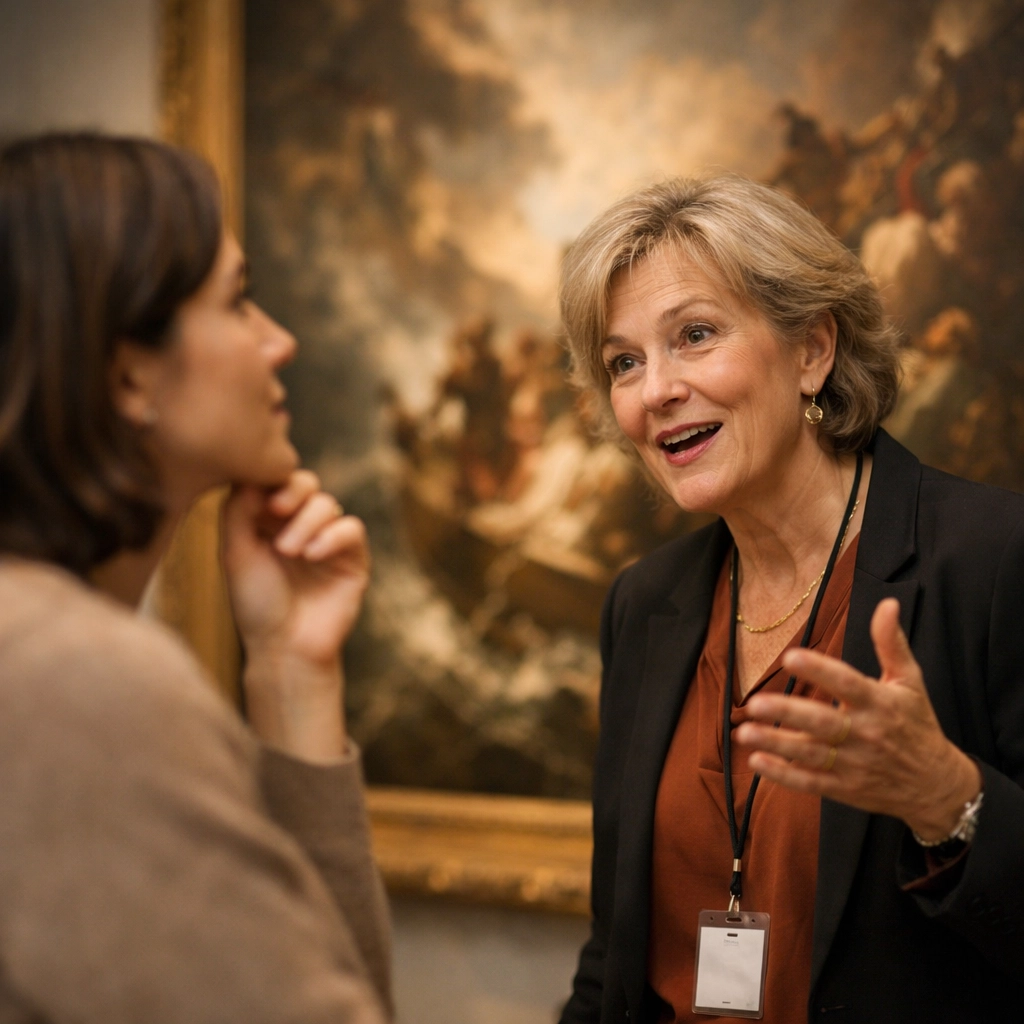
When we lead Private Museum Tours NYC, we aren't just reciting facts. We are weaving a narrative. If I see your eyes linger on a particular brushstroke, we stop. We pivot. We dive into the artist’s scandalous love life or the political uprising that was happening outside their studio window while they painted. A recording can't see your curiosity. A historian feeds it. That's the Art of the Narrative: Why an Expert Historian Outshines an Audio Guide.

The Power of the "Why" (And the Real-Time Answer)
The most frustrating thing about an audio guide is its inability to answer a question. You’re standing there, contemplating a complex installation like those found in the Mahmoud Hamadani private art collection, and a question pops into your head. You look at the device. It stares back, mute, waiting for you to press '4'.
With guided museum tours, the experience is interactive. You can ask: “Why did the curator put these two pieces next to each other?” or “What happened to this artist during the war?”
Our historians have "insider staff" knowledge that isn't printed on the wall plaques. We know which pieces are currently on loan, which ones were almost destroyed in a fire, and which ones have secret sketches hidden underneath the top layer of paint. That level of contextual depth transforms a museum visit from a "walk-through" into a masterclass.
The Art of the Narrative: Why an Expert Historian Outshines an Audio Guide: Reading the Room (Literally)
Have you ever tried to navigate the Met on a Saturday afternoon with an audio guide? It’s a sensory nightmare. You’re trying to listen to a soothing voice talk about the Renaissance while being jostled by a tourist group and accidentally walking into a restricted area because you weren't looking up.
A private guide is your human shield and GPS combined.
Part of the value of Private Museum Tours NYC is the logistical ease. We know the shortcuts. We know which galleries are currently empty and which ones are about to be swarmed. We time your visit so you’re standing in front of the Temple of Dendur exactly when the light hits the glass just right. You don't have to look at a map; you just have to look at the art.

Tailoring the Experience: From Toddlers to Tech Titans
One size does not fit all in the art world. An audio guide treats a ten-year-old the same way it treats a seasoned collector. That’s a recipe for boredom (for the kid) or frustration (for the collector).
When we design a tour, we curate the content based on who is standing in front of us. If we’re looking at the Richard Wiesel private art collection, the way we discuss his evocative photography changes if we're speaking to a group of corporate executives versus a family with teenagers.
We can lean into the technical aspects of photography, the historical weight of the subjects, or the emotional storytelling. This level of customization is why people who are "on the fence" about private tours usually become lifelong converts after the first twenty minutes.
Finding the Hidden Gems
Audio guides focus on the "Greatest Hits." They want to make sure you see the things that are on the postcards. But some of the most moving experiences in a museum happen in the quiet corners, the pieces that don't have a number next to them.
Our historians love the underdogs. We might skip the crowded masterpiece everyone is taking selfies with to show you a small, exquisite piece in a side gallery that tells a more compelling story. We might introduce you to the contemporary genius of the Kate Clark private art collection or the intricate textures of the Tatiana Arocha private art collection.
These are the moments that stick with you. Not the fact that you saw the famous thing, but that you discovered something new.
The Emotional Connection
Art is an emotional medium. It was created by people who felt deeply, pain, joy, anger, rebellion. A pre-recorded voice, no matter how well-acted, often strips that emotion away in favor of academic neutrality.
A live historian brings the passion. We love this stuff. (Seriously, ask us about the Noel Anderson private art collection if you want to see our eyes light up). That enthusiasm is contagious. It turns a "quiet, respectful" museum visit into an exhilarating intellectual adventure.
Addressing the "But" (Wait, isn't it expensive?)
I hear this a lot: "But Penny, an audio guide is five bucks, and a private historian is an investment."
And you’re right. It is an investment. But I want you to think about what you’re actually buying. You aren't just paying for someone to walk next to you. You’re paying for:
Years of academic research and expertise.
The luxury of a completely stress-free logistics plan.
A personalized education that sticks in your brain longer than a week.
Access to "insider secrets" and curator-level insights.
If you’re traveling to New York, your time is your most precious currency. Why waste three hours of it being bored by a recording when you could spend two hours being inspired by an expert? Don't waste your time: invest it.
Ready to Step Behind the Velvet Rope?
The difference between an audio guide and a live historian is the difference between reading a menu and eating a five-course meal prepared by a private chef. Both will tell you what’s available, but only one will leave you truly nourished.
Whether you are interested in the classical masters or the cutting-edge works in the Yongjae Kim private art collection, we’re here to make sure your experience is nothing short of extraordinary.
If you're still not sure what to expect, take a look at our Frequently Asked Questions to see how we handle everything from group sizes to custom itineraries.
The galleries are waiting. The stories are ready to be told. Are you ready to hear them?

Takeaway Questions for Your Next Visit:
What is the one question you've always wanted to ask an art historian but didn't have the chance?
Do you prefer the quiet solitude of headphones, or the dynamic energy of a shared conversation?
What was the last piece of art that truly made you feel something, and do you know the story behind it?
Ready to ditch the headphones? Contact us today to book your next adventure.


Comments